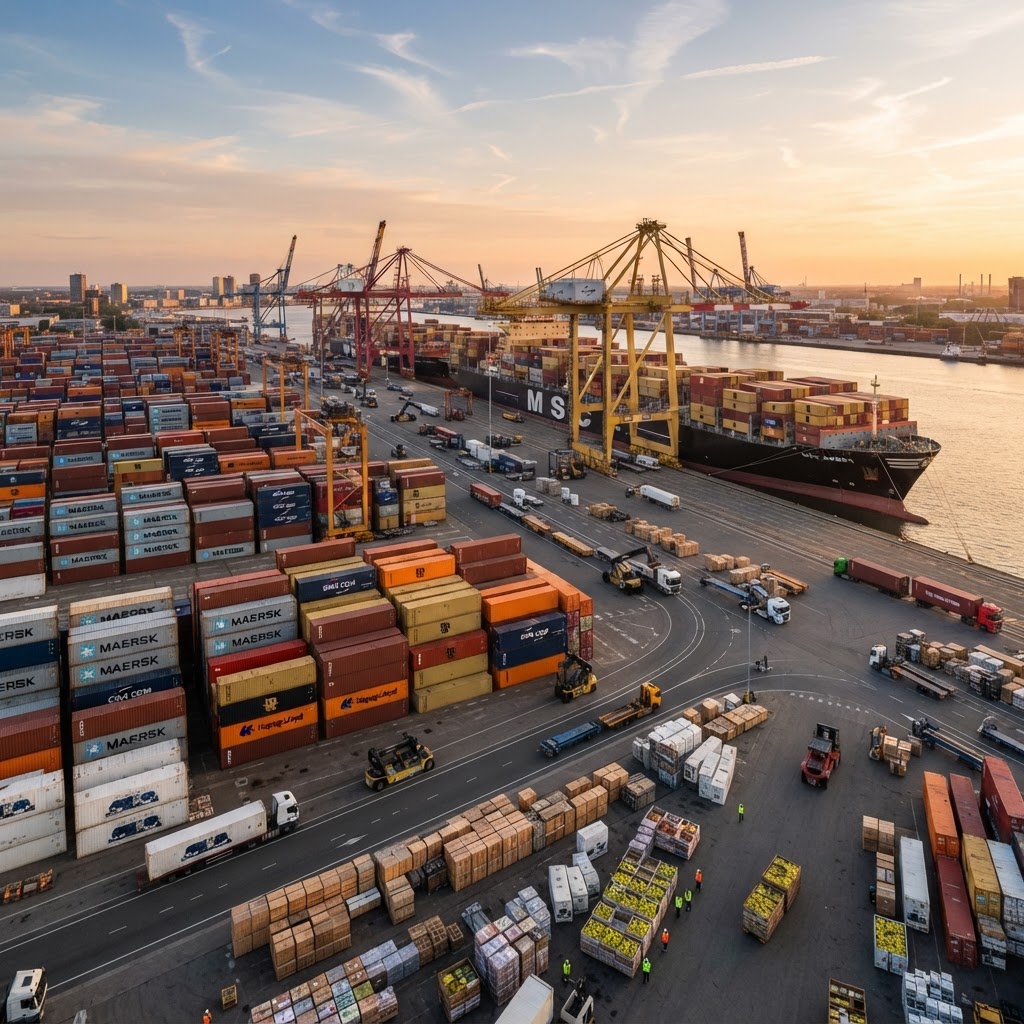
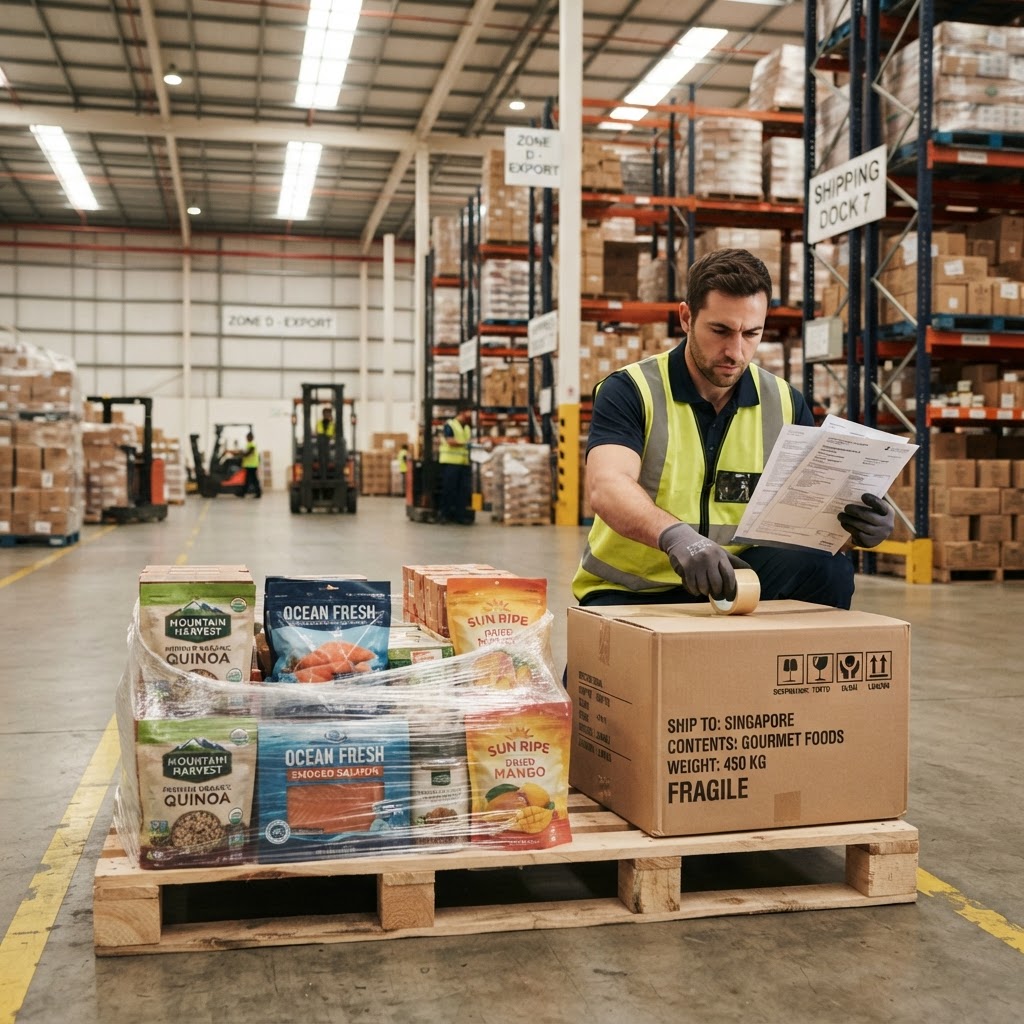
Exporting food can open the door to new customers, larger orders and more resilient revenue. It also adds steps that do not arise in a domestic sale: checking whether a product is permitted in the destination, meeting local labelling rules, preparing export documents, preserving quality in transit and finding a reliable importer or distributor. A sound process makes these steps manageable.
This beginner’s guide explains how to export food products from market research through delivery. Regulations vary by product and country, so treat the guidance as a planning framework, then confirm current requirements with the destination authority, your competent authority and an experienced customs or trade professional.
How do you choose the right export market for food products?
Start with a product-market fit assessment, not a list of the world’s largest food markets. A market is attractive only when buyers want your product, you can legally sell it, and the full landed cost leaves enough margin for you and your partners.
Assess demand, competition and route to market
Look for evidence of demand: category imports, retail and foodservice trends, buyer enquiries, competitor products and local price points. Trade associations, government trade offices, customs data, trade fairs and conversations with local importers can help you validate assumptions. Compare similar products by pack size, ingredients, claims, shelf life and price—not just by category name.
Then identify how products are sold. A packaged snack might enter through an importer-distributor serving supermarkets, while frozen seafood may require a specialist cold-chain importer and foodservice accounts. The best first market is often one where you have a credible buyer, manageable logistics and a clear compliance path, rather than the market with the biggest headline population.
Use a market-screening comparison
| Factor | Questions to ask | Why it matters |
|---|---|---|
| Demand | Is the category growing? Are buyers seeking this origin, format or price point? | Helps avoid spending on approvals for weak demand. |
| Regulatory fit | Are ingredients, additives, claims and packaging permitted? | Some products need approvals or facility registration before shipment. |
| Economics | What are freight, duty, taxes, clearance, commissions and expected selling price? | Shows whether the landed product can compete profitably. |
| Logistics | Can the product reach buyers within its shelf life and temperature limits? | Important for chilled, frozen and short-life goods. |
| Partner access | Can you identify a capable importer or distributor with relevant channels? | A partner can help with local access and operational requirements. |
Score shortlisted markets against these factors and investigate the strongest two or three. Build a basic landed-cost model before quoting: include product cost, export packing, inland transport, freight, insurance, duties, clearance, local handling and partner margin. Duties and taxes depend on the product classification, origin and destination; have the tariff treatment verified rather than relying on an informal estimate.
What do international food buyers require from exporters?
Buyers assess more than taste and price. They need confidence that the product is consistent, legal to import, correctly documented and supported by a dependable supply plan. Requirements vary by buyer and market, so request the buyer’s written product and vendor specification early.
Prepare a buyer-ready product file
- Product specification: Ingredients, allergen declaration, nutrition data, product format, net weight, tolerances and preparation or storage instructions.
- Quality and safety information: Relevant food-safety certifications, hazard controls, traceability procedure, testing records and audit information. Buyers may request different schemes or evidence.
- Commercial details: Price and currency, minimum order quantity, production lead time, payment terms, capacity and quotation validity.
- Shelf-life evidence: Total shelf life, minimum remaining shelf life on arrival and any supporting stability or validation data.
- Samples: Representative, correctly packed samples with clear identification. Confirm whether sample import rules apply.
- Supply assurance: Forecasting, batch consistency, complaint handling, recall contact and contingency planning.
Be precise about claims such as organic, gluten-free, vegan, halal or “natural.” A claim accepted in one jurisdiction may need certification, substantiation or different wording in another. Ask the buyer which evidence its market and sales channels require.
What documents are needed to export food products?
There is no single universal export document set. Requirements depend on the product, origin, destination, transport mode, trade agreement and import rules. Confirm the exact list with the importer and the relevant authorities before production or dispatch.
Common export and food documents
- Commercial invoice: Identifies the seller, buyer, goods, quantities, values, currency and agreed sale terms.
- Packing list: Shows package counts, weights, dimensions and how goods are packed.
- Transport document: For example, a bill of lading for sea freight or an air waybill for air freight.
- Certificate of origin: States the origin under applicable rules; a chamber or authority may need to issue or certify it.
- Health or sanitary certificate: May be required for certain foods and is generally issued by a designated competent authority.
- Phytosanitary certificate: May apply to regulated plants and plant products, depending on the commodity and destination.
- Product and facility approvals: Some destinations require prior registration, listing, permits or import licences.
- Additional records: Examples include temperature logs, laboratory results, insurance certificate, treatment certificate or ingredient declarations.
Check that names, addresses, product descriptions, quantities, lot codes, weights and origin details match across documents. A small inconsistency can delay clearance. Food businesses should also maintain traceability records linking inputs and production lots to each shipment, so affected goods can be identified quickly if a safety issue arises.
Product classification is another essential step. The Harmonized System (HS) code influences customs declarations and may affect duty, restrictions and statistical reporting. Classification can be nuanced, especially for processed or composite foods. Ask a customs broker or competent trade adviser to confirm the code and any destination-specific extensions.
How should you label and package food for export?
Export packaging has two jobs: protect the food through handling and transport, and present the information required by the destination market. Do not assume that a label compliant at home will be accepted abroad.
Check label rules before printing
Depending on the country and product, mandatory label details may include the product name, ingredients in descending order, emphasized allergens, net quantity, nutrition information, lot identification, date marking, storage instructions, country of origin, responsible importer and language requirements. Some markets prescribe units, date formats, placement, minimum type size or rules for nutrition and health claims.
Ask the importer to review artwork, but retain independent verification against official rules. A buyer’s approval is useful operationally; it does not necessarily transfer the manufacturer’s legal responsibility. Where translation is required, use a qualified reviewer familiar with food terminology. Keep version-controlled artwork and records of who approved each version.
Match packaging to product and journey
- Choose food-contact materials suitable for the food, temperature and intended storage period.
- Validate seals, closures and barrier properties against moisture, oxygen, light or leakage risks.
- Use transport cartons and pallet configurations that withstand stacking, vibration and handling.
- For chilled or frozen goods, define temperature limits, monitoring method and action if a limit is breached.
- Check pallet, wood-packaging and container requirements for the destination and carrier.
- Mark cases with readable product identification, lot details, handling instructions and any required shipping marks.
Example: A sauce maker planning a first export may find that its glass jars meet the destination’s food-contact and label rules but are vulnerable to breakage on a long route. A transit trial with dividers, stronger cartons and a pallet drop or handling assessment can reveal the issue before a full commercial shipment is lost.
How do you plan food shipping and cold-chain logistics?
Select the mode based on shelf life, temperature, order size, cost and delivery timing. Air freight is generally faster but more expensive; ocean freight can reduce cost per unit but adds transit time and port handling. Road or rail may be practical in connected regions. Compare the full journey, including pickup, export clearance, transshipment, destination clearance and final delivery.
| Shipment type | Useful for | Main planning concern |
|---|---|---|
| Ambient, sea freight | Stable products with adequate shelf life and larger volumes | Transit duration, moisture, container condition and stock cover |
| Air freight | Urgent, high-value or short-life products and samples | Higher freight cost, capacity and temperature control |
| Refrigerated or frozen freight | Products with defined chilled or frozen requirements | Continuous temperature control, handoffs and contingency response |
| Road or rail | Regional trade where routes and border procedures are suitable | Border delays, documentation and route-specific temperature risks |
Agree on the delivery term using the current Incoterms® rules and state the named place precisely. Incoterms allocate certain costs, risks and responsibilities between seller and buyer; they do not by themselves set payment terms, transfer ownership or replace a sales contract. Ensure both parties understand who arranges freight, insurance, export and import clearance, and unloading.
For temperature-sensitive goods, set a written cold-chain plan: required range, pre-cooling, loading procedure, calibrated monitoring, data review, escalation contacts and backup arrangements. Ask the carrier how temperatures are recorded and who can access the records. Also account for customs inspection or port delays when calculating usable shelf life on arrival.
What destination-market checks should exporters complete?
Before confirming an order, verify that the product can enter and be sold in the destination. Rules can differ substantially between countries and may also vary by product category within one country. Confirm current requirements with the importing authority and a local importer or qualified adviser.
- Are all ingredients, additives, processing aids and food-contact materials permitted?
- Does the product, manufacturer or foreign facility need registration or pre-approval?
- Are import permits, health certificates, inspection or laboratory testing required?
- Does the label meet language, format, allergen, date-marking and claims rules?
- Are there restrictions tied to animal or plant origin, production method, or disease status?
- What are the HS classification, customs duty, taxes and applicable trade preferences?
- Are there rules for packaging waste, recycling marks, wood pallets or product-specific schemes?
- What records must the importer hold, and how long must they be retained?
Regulatory sources should be official and current: destination food-safety and customs authorities, the exporting country’s competent authority, and relevant treaty or standards bodies. International standards can provide a useful reference, but national law determines what is enforceable in a specific market.
How do you find and manage an international food distributor?
A distributor can provide market knowledge, import capability, warehousing, sales coverage and access to retailers or foodservice accounts. The right partner is not simply the one promising the largest volume; it is the one able to represent the product responsibly and execute the route to market.
Evaluate potential partners
- Check company registration, reputation, financial capacity and trade references.
- Ask which channels and regions it serves, and request relevant category examples.
- Confirm its experience with food imports, clearance, storage conditions and local compliance.
- Discuss sales forecasts, launch investment, marketing support, reporting and payment history.
- Clarify whether it expects exclusivity, and define measurable performance conditions.
Use a written agreement covering territory, products, pricing, currency, payment, forecast and order process, delivery terms, marketing responsibilities, intellectual property, quality complaints, recalls, confidentiality and termination. Define what happens to remaining stock and approved packaging if the relationship ends. Have the contract reviewed for the relevant jurisdictions.
Example: A small producer receives an offer of exclusive nationwide representation. Instead of granting permanent exclusivity on day one, it could agree to a limited trial period and territory, with exclusivity continuing only if the distributor meets agreed sales, reporting and compliance milestones. This balances commitment with protection against an inactive channel.
Horeca 360’s global trade and export solutions can be a useful starting point for businesses exploring cross-border supply. You can also review our sourcing capabilities, product catalogue and FMCG distribution services to understand how supply and distribution partnerships may fit your plans.
What is a practical first-shipment checklist?
Use this checklist before releasing a commercial shipment. Assign an owner and completion date to each item; do not rely on assumptions or verbal assurances for critical approvals.
- Market demand and a viable landed-cost model are documented.
- Importer and sales channel have been assessed and commercial terms agreed.
- Destination product eligibility, facility status and permits are verified.
- Product specification, allergen data, claims and buyer requirements are approved.
- Label artwork and packaging are checked for the destination and transport route.
- HS code, origin rules, duties and customs process are confirmed.
- Certificates, invoice, packing list and transport documents are assigned and checked.
- Production lot, traceability, shelf life and remaining-life-at-arrival are acceptable.
- Carrier, Incoterm, insurance, temperature controls and delivery contacts are agreed.
- Contingency plans cover delay, rejection, temperature excursion and product recall.
How to export food products successfully: build a repeatable process
Successful food exporting is a controlled sequence: select a market, validate buyer demand, confirm regulatory access, adapt product information and packaging, calculate landed cost, choose a capable partner, and ship with complete records. Treat the first shipment as a learning milestone. Review clearance time, product condition, customer feedback and actual costs, then update specifications and procedures before scaling volume.
Export rules are not identical worldwide, and they change. Verify requirements for each destination and product before accepting an order or printing packaging. With careful preparation, clear responsibilities and reliable partners, manufacturers can turn an initial export opportunity into a sustainable international business.
Frequently Asked Questions
What is the first step in exporting food products?
Choose a promising market and validate demand, buyer access, regulatory feasibility and landed cost together. Before taking an order, confirm that the exact product and manufacturer can meet the destination’s import requirements.
Do food exporters need a certificate of origin?
It depends on the destination, product, buyer and customs arrangement. A certificate may be required for clearance or to claim preferential duty treatment. Confirm the origin rules and required issuing authority for the shipment.
Can I use my domestic food label in another country?
Not necessarily. Ingredient declarations, allergen emphasis, language, nutrition panels, date formats, claims and importer details may differ. Check the destination’s current rules and approve compliant artwork before production.
How do I choose between air and sea freight for food?
Compare total cost, transit time, product shelf life, order volume and temperature needs. Air may suit urgent or short-life shipments; sea freight may suit larger, stable products when there is sufficient shelf life and reliable handling.
Should a new exporter give a distributor exclusivity?
Only after due diligence and clear commercial protections. Consider a limited trial, territory and term, with exclusivity tied to measurable sales, reporting and compliance milestones. Put responsibilities and exit terms in a written agreement.