
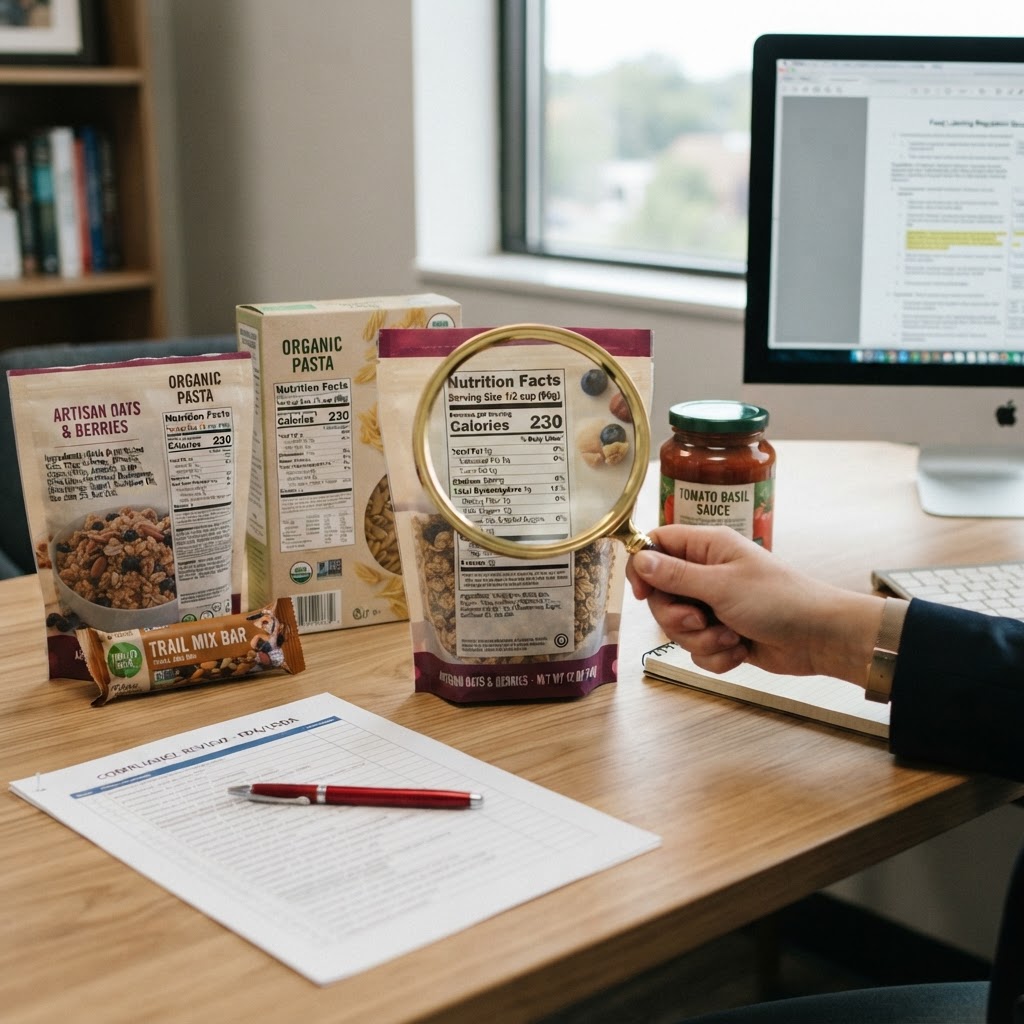
Food labelling requirements: what every label needs to communicate
Food labels are both a source of consumer information and a regulated part of placing a product on the market. They help people identify what a food contains, assess whether it suits their dietary needs, understand how to store and use it, and evaluate claims made by the brand. For manufacturers, importers and distributors, a compliant label also supports traceability and reduces the risk of recalls, rejected shipments or enforcement action.
The phrase food labelling requirements covers several topics: ingredient declarations, allergen statements, nutrition information, product identity, net quantity, origin, date marking, storage instructions and marketing claims. International standards offer useful common principles, but the law that applies depends on the destination market, product type, sales channel and sometimes the language or format of sale. A label accepted in one country may need changes before it can be sold in another.
This guide explains the core principles and provides a practical review process. Treat it as a planning resource, not a substitute for checking current local legislation or obtaining specialist regulatory advice.
Which food label elements are commonly required?
Many jurisdictions require some combination of the elements below. Exact rules, exemptions and presentation standards differ, so confirm the requirements for each product and market before printing packaging.
| Label element | What it tells the consumer | Common compliance check |
|---|---|---|
| Name of the food | The product’s legal, customary or descriptive identity | Is the name accurate and not misleading? |
| Ingredients | What was used to make the food | Are ingredients listed in the required order and under acceptable names? |
| Allergen information | Whether regulated allergens are present | Are allergens declared in the required form and clearly visible? |
| Net quantity | The amount of food in the package | Are units, placement and measurement rules correct? |
| Nutrition information | Energy and selected nutrients per defined basis | Are values, units, rounding and serving declarations compliant? |
| Responsible business details | Who makes, packs, imports or distributes the product | Does the market require a local operator or address? |
| Origin and date marking | Where the product comes from and its relevant date | Are origin statements substantiated and date terms appropriate? |
| Storage and use instructions | How to handle, prepare or store the food | Are instructions clear, safe and supported by product evidence? |
Some products have additional rules. Infant foods, supplements, foods for special dietary uses, alcoholic beverages, meat, seafood and products making nutrition or health claims may be subject to specific standards. Food sold loose or through food service may also be treated differently from a sealed retail package.
How should ingredients be declared on a food label?
Ingredient lists generally name the components used to make a food, usually in descending order by weight at the time of manufacture. This means the first listed ingredient is commonly the one used in the greatest quantity, subject to local rules and exceptions. Compound ingredients—such as chocolate chips, seasoning blends or pastry—may need their own component ingredients shown, unless an exemption applies.
Ingredient declaration checklist
- Use accurate, recognised names. Check whether local rules prescribe a specific name for an ingredient, additive, sweetener, oil or processing aid.
- Confirm the order. Build the list from the approved formula and verify the required weight basis and any category-specific exceptions.
- Break down compound ingredients where required. Obtain current specifications from each supplier rather than relying on an old label or invoice.
- Declare additives correctly. Some markets require a functional class, specific name, identification number or a combination of these.
- Check carry-over and processing aids. Their declaration treatment varies; do not assume that something used in a small amount is automatically exempt.
- Reconcile label and production records. A recipe change, supplier substitution or reformulation can make an existing declaration inaccurate.
Example: A ready-made sauce contains a spice blend supplied by a third party. The blend’s specification lists mustard, but the finished-product artwork says only “spices.” The manufacturer should assess the applicable allergen rules and ingredient naming requirements, request an up-to-date specification and revise the label if needed. A supplier’s assurance is useful evidence, but it does not replace the responsible business’s label review.
How must food allergens be declared?
Allergen labelling is a high-risk area because an undeclared allergen can cause serious harm. Many systems require specified allergens to be identified when they are intentionally present, often within the ingredient list and sometimes in a separate “contains” statement. The regulated allergen list is not identical everywhere: the number of listed allergens, treatment of particular cereals or nuts, and rules for derivatives can vary.
Formatting requirements also differ. A jurisdiction may require allergens to be emphasised within the ingredient list—for example, through bold type—or may prescribe a separate declaration. Where both approaches are permitted, clear and consistent presentation helps consumers, but voluntary repetition should not create contradictions.
Precautionary allergen statements and cross-contact
Statements such as “may contain” or “made in a facility that also processes” are generally intended to communicate a genuine, assessed risk of unintended presence. They should not be used as a substitute for good manufacturing practices, supplier controls or a cross-contact risk assessment. The wording, permitted use and expectations for substantiation vary by market. Avoid blanket warnings added to every product without considering the actual production risk.
- Collect allergen information for every ingredient and sub-ingredient.
- Assess shared equipment, handling, rework, storage and transport risks.
- Apply cleaning and segregation controls, then verify their effectiveness.
- Review precautionary wording against local rules and documented risk assessment.
- Reassess after supplier, recipe, factory or production-line changes.
What belongs in a nutrition facts panel?
Nutrition declarations commonly show energy and selected nutrients, but the required nutrients and layout depend on the market and food category. Rules may specify whether values are given per 100 g, per 100 ml, per serving, or in more than one format. They may also set requirements for units, rounding, order, reference values, serving sizes and the design or placement of the panel.
Nutrition values may be established through laboratory analysis, calculation from reliable ingredient data, or another method accepted by the relevant authority. Whichever approach is used, the business should retain the underlying evidence and ensure it reflects the product as sold. Natural variation, processing, recipe tolerances and analytical uncertainty can affect results.
Nutrition panel review checklist
- Confirm whether a nutrition declaration is mandatory or an exemption applies.
- Use the correct market-specific nutrient list, order, units and format.
- Verify the serving basis and ensure any stated serving is realistic and clearly explained.
- Check values against the final formula, supplier specifications and appropriate analysis or calculation records.
- Review front-of-pack symbols, traffic-light systems or other summary schemes where applicable.
- Recalculate and reapprove the panel when the recipe, serving size or manufacturing process changes.
A label may show nutrition information voluntarily in one country but be required in another. Some jurisdictions require specific front-of-pack systems for defined products; others allow voluntary schemes subject to conditions. Do not copy a panel from a different market without checking its rules and data basis.
When can a food label make origin and product claims?
Origin information can refer to the country where a food was grown, raised, caught, manufactured or substantially transformed. These concepts are not always interchangeable. A product packed in one country using ingredients from several others should not imply that all ingredients originate in the packing country unless that statement is accurate and legally permitted.
Origin disclosure may be mandatory for particular foods, circumstances or sales channels, while broader origin claims may be voluntary but still subject to truthfulness requirements. Importers should check both food-labelling legislation and applicable customs or trade rules. Keep supporting records such as supplier declarations, production records and certificates where relevant.
How to assess common product claims
| Claim type | What to verify | Potential issue |
|---|---|---|
| “Natural” | Whether the term has a local legal definition or established conditions | It may imply more than the product’s ingredients or processing support. |
| “Organic” | Certification, scope, logo permission and market recognition | Rules may require approved certification and specific wording. |
| “Gluten-free” | Applicable threshold, testing or control evidence, and ingredient suitability | Standards and permitted claims can differ across markets. |
| “Low fat” or “high protein” | Local nutrient-claim criteria and calculation basis | A claim may be allowed only if defined numerical conditions are met. |
| “No added sugar” | Whether sugars or sugar-containing ingredients were added, and required accompanying statements | The phrase may be restricted even if the product contains naturally occurring sugars. |
| “Made in…” or “Product of…” | Origin criteria, transformation steps and evidence | Manufacture, packing and ingredient origin may be confused. |
Health claims need particular care. A statement suggesting that a food prevents, treats or cures a disease may be prohibited or regulated as a medicinal claim. Even permitted nutrition and health claims often have defined wording, eligibility thresholds and supporting-evidence requirements. Marketing, packaging, websites and sales materials should be reviewed together; a claim does not become compliant simply because it appears outside the physical label.
Why do food labelling requirements differ by country?
International standards, including Codex Alimentarius texts, provide widely used reference principles for food information and labelling. They support consistency in areas such as truthful presentation and ingredient disclosure, but they do not automatically replace national law. Countries and regional blocs adopt their own legislation, amend standards and set different implementation dates, exemptions and enforcement practices.
| Topic | Common international principle | Where local rules may differ |
|---|---|---|
| Language | Consumers should be able to understand required information. | Official language, translation, bilingual text and placement requirements. |
| Allergens | Important allergenic ingredients should be communicated clearly. | Listed allergens, emphasis style, “contains” statements and precautionary wording. |
| Nutrition | Nutrition information should be accurate and not misleading. | Mandatory nutrients, panel format, exemptions, rounding and front-of-pack schemes. |
| Claims | Claims should be truthful and substantiated. | Definitions, thresholds, approved wording and evidence standards. |
| Origin | Origin information should not mislead. | Foods requiring origin disclosure and criteria for origin statements. |
| Dates and codes | Date information should support safe and informed use. | Required date terminology, format, shelf-life rules and lot-code conventions. |
For example, an exporter may need a translated label, a local importer’s details, a different allergen emphasis format and a revised nutrition panel for the destination market. These are not merely design changes: they must be checked against the product’s approved formula, evidence and legal classification. For market-entry planning, review your supply chain and documentation through Horeca 360’s global trade and export solutions or discuss product requirements with the team via Contact Horeca 360.
How can manufacturers and distributors manage label compliance?
A reliable labelling process combines regulatory review with document control and change management. Responsibility can be shared across manufacturers, brand owners, importers and distributors, but contracts do not necessarily remove legal duties imposed on a particular operator. Agree who approves artwork, verifies translations, maintains specifications and releases each market version.
Practical pre-approval checklist
- Define the market and product category. Identify destination countries, sales channel, package type and any special category rules.
- Freeze the product specification. Confirm ingredients, sub-ingredients, processing aids, allergens, nutrition data, shelf life and storage conditions.
- Map required label information. Create a market-specific checklist for identity, quantity, dates, responsible business details, language and any required marks.
- Substantiate every claim. Link each claim to legal criteria and supporting records, tests or certification.
- Review the actual artwork. Check legibility, contrast, placement, translations, units, symbols and consistency across all panels.
- Approve a controlled version. Record the market, product code, artwork version, review date and approvers.
- Monitor change triggers. Reassess labels after ingredient substitutions, supplier changes, reformulation, new claims, rule updates or market expansion.
- Retain evidence. Keep specifications, analyses, certificates, origin records, approvals and corrective-action documentation accessible.
Distributors should request current, market-appropriate product specifications rather than assuming that packaging supplied for another country is ready for sale. Horeca 360 supports food businesses with product sourcing and supply coordination; explore sourcing, browse the catalogue, or learn about food supply options. For private-brand products, agree label ownership and approval responsibilities early through the private-label service.
What are common food label compliance mistakes?
- Using artwork approved for one country in a different market without a regulatory check.
- Relying on supplier specifications that are outdated, incomplete or inconsistent with the current formula.
- Omitting allergens hidden in compound ingredients or overlooking a substitute ingredient.
- Using nutrition values from a previous recipe or presenting serving data on an unclear basis.
- Making broad claims such as “healthy,” “natural” or “sustainable” without checking how consumers may interpret them and whether evidence supports them.
- Adding precautionary allergen wording as a routine disclaimer instead of managing cross-contact risks.
- Failing to update labels after changes to origin, ingredients, manufacturing site or local legislation.
- Allowing marketing materials, online product listings and the package to make inconsistent claims.
A good label is not simply attractive packaging. It is a controlled, evidence-based communication tool that should match the product, the market and the information available to the responsible business.
Frequently Asked Questions
Are food labelling requirements the same in every country?
No. International standards provide common principles, but countries and regional blocs set their own binding requirements. Language, allergens, nutrition formats, origin disclosures and claim rules are among the areas that can differ. Check the current rules in every destination market.
Does every packaged food need a nutrition panel?
Not necessarily. Some markets require nutrition declarations for most packaged foods, while exemptions may apply to certain products, small businesses or package formats. Voluntary nutrition information may also trigger additional rules. Confirm the applicable exemptions and presentation requirements locally.
Can a manufacturer use “may contain” on every product?
Blanket precautionary statements are not a replacement for allergen controls and may reduce the usefulness of warnings. Assess actual cross-contact risk, document preventive measures and use wording only in line with the destination market’s rules and guidance.
Who is responsible for a compliant label: the manufacturer or importer?
Responsibility depends on the law, the operator’s role and the supply arrangement. Manufacturers, brand owners and importers may each have duties. Contracts should assign review and approval tasks, but businesses should verify their own legal obligations in the market where the food is sold.
When should a food label be reviewed again?
Review it whenever the recipe, supplier, production site, packaging, claim, destination market or relevant regulation changes. Periodic review is also useful to confirm that specifications and evidence remain current and that the printed label still matches the product being supplied.